
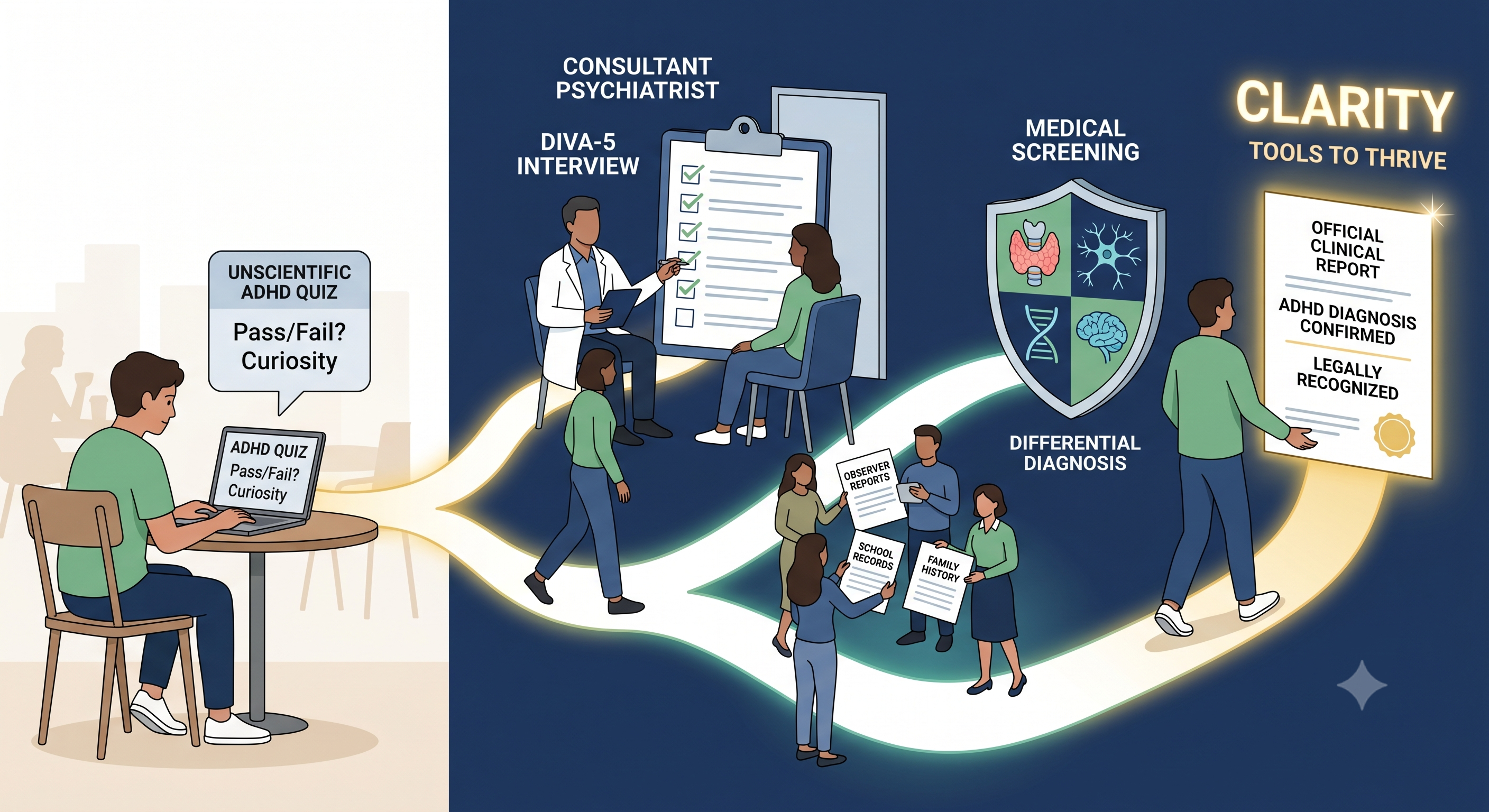

In the age of social media, it is easier than ever to find "ADHD quizzes" that promise to tell you if your brain works differently. While these online screenings can be a helpful first step in recognizing patterns of behavior, they are significantly different from a professional clinical evaluation.
If you are considering an ADHD assessment test, it is important to understand what happens when you move beyond the initial quiz and enter a formal clinical environment. A formal assessment is not just a "test" you pass or fail; it is a comprehensive investigation into your neurodevelopmental history.
The Limitation of Online "Quizzes"
Most online screenings are "self-report" tools. They rely entirely on your own perception of your symptoms at a single point in time. While useful for raising awareness, they cannot account for:
Co-occurring conditions: Anxiety, depression, or sleep disorders often mimic ADHD.
Childhood onset: ADHD is a neurodevelopmental condition, meaning symptoms must have been present before age 12.
Functional impairment: A diagnosis requires evidence that symptoms significantly interfere with your life in two or more settings (e.g., work and home).
The Architecture of a Formal Assessment
A formal evaluation conducted by a Consultant Psychiatrist involves several specialized ADHD assessment tools designed to provide a 360-degree view of your cognitive and emotional life.
1. The Diagnostic Interview (The DIVA-5)
The cornerstone of an adult ADHD assessment test is the Structured Diagnostic Interview. In Ireland, the "gold standard" is the DIVA-5. This interview systematically walks through the DSM-5 criteria, looking for 18 specific symptoms across two categories: Inattention and Hyperactivity/Impulsivity.
Crucially, the clinician doesn't just ask if you are "distractible"; they ask for real-world examples from both your current adult life and your life as a child.
2. Standardized Rating Scales
To provide objective data, psychiatrists use validated ADHD assessment tools like the Conners’ Rating Scales (for children) or the Barkley Adult ADHD Rating Scale (BAARS).
Self-Report: You complete a detailed questionnaire about your own symptoms.
Observer Report: Ideally, a "collateral" informant—such as a parent, spouse, or long-term friend—completes a similar form. Seeing the discrepancy or alignment between how you see yourself and how others see you is a vital clinical data point.
3. Developmental History and Document Review
Because ADHD is present from birth, a formal assessment involves looking back. Your psychiatrist may ask to see:
Primary or secondary school reports (looking for comments like "bright but lacks focus" or "daydreams in class").
Previous medical or psychological evaluations.
Family history (ADHD has a high genetic heritability).
4. Differential Diagnosis (The Medical Review)
This is where the "test" becomes a medical evaluation. The psychiatrist reviews your physical health, looking for medical explanations for "brain fog" or restlessness, such as thyroid issues or iron deficiencies. This ensures that if you are diagnosed with ADHD, it is the most accurate explanation for your struggles.
Why the "Formal" Label Matters
In Ireland, a "quiz" result will not be accepted by the HSE, the Department of Education (for DARE/exam supports), or by employers for workplace accommodations.
A formal assessment results in a comprehensive Clinical Report. This document is a legal and medical record that:
Confirms the diagnosis based on international criteria (DSM-5 or ICD-11).
Outlines the specific tools used.
Provides a roadmap for treatment, whether that includes medication, therapy, or lifestyle adjustments.
Summary: From Curiosity to Clarity
An online quiz is a spark of curiosity. A formal ADHD assessment test is the journey to clarity. By using professional ADHD assessment tools and clinical expertise, a Consultant Psychiatrist helps you move past "maybe" and into a future where you have the tools and understanding to thrive.
Ready to go beyond the quiz? Our clinical team uses the most rigorous, evidence-based assessment tools to provide you with a diagnosis you can trust. [Learn more about our assessment process here.]